 by Wanda Kamarga
Click for a better view of this.
Designers, this is what it looked like before it was made into software!
 by Wanda Kamarga
MENTAL HEALTH BREAK!
So THIS is how cars are built. Detroit, get your cake on!
Parkour, or Free Running, hit the global scene with the making of Jump London, in London in 2003. Since then, the skills of the art have been practiced vigorously on both high and low architectural structures. There is some contention that Parkour, founded by Frenchman, David Belle and Free Running, founded by Sebastien Foucan are really the same sport. However, the founders insist that there are distinct differences. Parkour as a discipline comprises efficiency, while free running embodies complete freedom of movement — and includes many acrobatic maneuvers. Although the two often look physically similar, the mindsets of each are vastly different. Parkour, strives for efficiency and humility, while Free Running strives for self-development and freedom. However, to make things simple, most in the West refer to all such activities as Free Running.
Just to emphasize the the importance of architecture to the sport, a new book "LA Climbs: Alternative Uses For Architecture" by author Alex Hartley, was recently released. The publication had a series of LA buildings analyzed not for architectural merit, but, rather, for how one might interact with the structure and space as field of unfolding sequences by someone running, hopping, climbing, as one would in Pakour or Free Running. The author provides a diagram of each structure he analyses for interaction. This use of architecture for sport could certainly give the planned functionality of the constructed world a wholly different slant. Heads up architects!
 Ihlow House - Berlin, Germany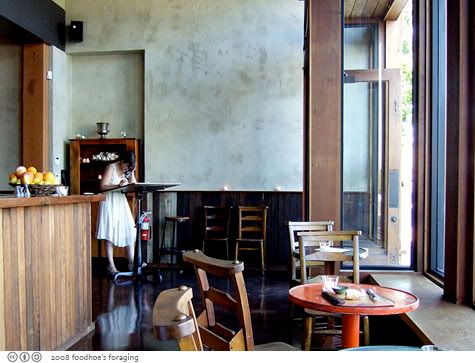
Camino Restaurant, Oakland CA
We were intrigued by a recent study at the University of Minnesota, indicating that high ceilings spur creative thinking. The study concludes that people in a high-ceiling room are "primed" to think broadly because of the sense of freedom associated with the space... while the containment of a lower-ceiling room encourages people to think small and focused. Read the article. PDF
This study comes out of the emerging field of "atmospherics." Atmospherics, primarily used for retail / consumer studies, examines the ways in which people's environment affects their thinking and well-being, but until now most research had focused on sensory factors such as smell or background music, not structural aspects. This information about spatial relations, usually intuited by designers, is now a matter of science.
 Rendering, Burj Tower, Dubai
 Maya Lin
 This may be the gift for a design, comic / graphic
 BLAB!: A Retrospective
1 August – 2 November 2008
Marianna Kistler Beach Museum of Art
Kansas State University
701 Beach Lane
Manhattan, KS 66506
OK. You are probably not going to be in Manhattan, Kansas anytime soon. But here's the design scoop.
This exhibition features an eclectic gathering of stylistically varied work by alternative comics artists, illustrators, graphic designers, printmakers, and painters from BLAB!, the annual anthology of visual art produced by Chicago-based graphic designer and art director Monte Beauchamp.
BLAB! began in 1986 as a self-published fanzine (fan-produced magazine) devoted to MAD magazine and other EC Comics publications. Today it is a significant outlet for a wide variety of contemporary artists. BLAB!'s influence has cut a broad swath across contemporary visual culture. It has helped launch many artists' careers. It has introduced American audiences to important contemporary European graphic and comics artists. And, it has contributed meaningfully to the blurring of boundaries between alternative graphics and mainstream illustration. All of the work in this exhibition has been featured in BLAB!
The good news is that the exhibition catalogue is available for the comic book fans in your life (rumor has it that President-elect Obama is a serious collector of comic books and graphic novels.) 128 pages; 84 color illus.; graphic design by Monte Beauchamp; essays by David A. Beronä, Mark Frauenfelder, and Bill North; in-depth interview with Monte Beauchamp by Matt Dukes Jordan.
ISBN-13: 978-1-890751-15-9; $20.
You can purchase this collector item by credit card, call 785-532-7718. Send check or money order for $20.00 plus $4.00 for shipping (via UPS) for the first copy, $1.00 for each additional copy, payable to Beach Museum of Art at:
Marianna Kistler Beach Museum of Art
Kansas State University
701 Beach Lane
Manhattan, KS 66506
 "Sweep" Banksy
For designers who are looking for a counter-intuitive Halloween object to carve, this is it!
Here are the directions:
# Slice off bottom of watermelon so it won't roll around.
# Peel green skin off of the watermelon.
# Score brainy folds in white flesh.
# With a sharp paring knife, carve channels out of melon to resemble cortical folds.
BOO! Again!

Famous British graffiti artist Banksy's first ever New York exhibition closes October 31. Get there if you can. The Big Apple for Halloween, think about it. Banksy's art installation, "The Village Pet Store and Charcoal Grill," will go down in art history. You will want to have BEEN there. Asked "Why a pet shop?" Banksy replied, "New Yorkers do not like art, they like pets. So I made a pet store."
Banksy's exhibit, a departure from his politically infused graffiti, features animatronic figures of familiar food, such as chicken. He puts the figures into weird situations that do not defy imagination, but, rather, boggle the mind. Banksy is attempting to explore our relationship with animals and the ethics and sustainability of factory farming, moving the viewer to question his or her conception of food and their relationship to it. A vegetarian will be the first to get it.
For those who won't make it to New York, here is the website for the exhibit. It is loaded with videos. Warning: Do NOT look at the sausage video. We're just sayin'. Here, also, is a good slide show provided by the BBC of images taken inside the fake pet shop.
The Banksy “Village Pet Store and Charcoal Grill” is open daily from now until Halloween, 10am until midnight! Midnight! Its location is 87th west and 7th. Not only is the exhibit free, but you’re allowed to take pictures/videos, too!

Metropolis magazine and the Maryland Institute College of Art present a conversation with editor in chief Susan S. Szenasy on the pressing need for research in design. Szenasy will screen Brilliant Simplicity: 15 Designers Research Collaborate Innovate, a short film that traces the many ways innovation can happen. The Metropolis Tour was designed to challenge you to rediscover the innovator within. Sponsored by Haworth, Interiors from Spain, Shaw Contract Group and Wilsonart Contract. 7 p.m., Free. Maryland Institute College of Art, The Brown Center, Falvey Hall, Baltimore, MD. http://www.metropolismag.com/mica
 Only seven days remain before 224 architecture firms from around the world prepare to compete for only one prestigious award. Showcasing all of the 722 projects submitted, the World Architecture Festival, 22-24 October, is the first event of its kind dedicated to architecture and architects from across the globe. Paul Finch, Editor of London's Architectural Review and Director of the awards, said that they wanted to “create an event where architecture was first in the chain”.
Participants at the event are aiming for one thing - to be the sole possessor of the World Building of the Year Award 2008. Despite the most diverse range of buildings competing there will be only one winner and there is no telling whether it will be a national stadium or a public toilet, anything goes.

 On October 9 MDI unveiled its answer to the need for clean air and urban mobility - the AIRPod. The AIRPod runs on compressed air! With its low price, zero pollution, high range and playful and futuristic design, the AIRPod marks a turning point in the nexus of automobile and urban transportation. And it will cost less than a Euro per 200 km to operate.
We are keeping posted on the vehicle which is promised to be available in the USA by 2010, with orders being taken in 2009. Here's the latest news in the bottom right corner of this link. Whooosh!


In July 2007, three Americans formed PFNC Global Communities -- PFNC stands for "Por Fin, Nuestra Casa," which roughly translates as "Finally, our own home." The company makes the homes you see above out of inexpensive, readily available, shipping containers. Their goal is to provide affordable housing for some of the poorest in Cuidad Juarez, Mexico. These poor now live in houses made of scraps of paper and tin. PFNC wants factories who employ these people to offer homes as part of workers' benefits. Their plan may be working.
These diminutive homes are 320 square feet, around $8,000 with kitchen, bath, sleeping area. When drawings and color pictures of the prototype were shown around a poor Juarez neighborhood, people said, "You know it'd be like a dream to live in one of these," Nava said. "You know, just the thought of having nice fresh air ventilating through the house, a large bed ... a normal kitchen and a safe home that locks and closes each night was more than appealing."
The article about this project appeared on the CNN website. Brian McCarthy, the man who conceived of this idea, was visiting factories in Ciudad Juarez, across the boarder from El Paso, Texas, as part of finishing his MBA. After visiting the factories, a bus ride took him into an area of hundreds of ramshackle, tiny, paper and tin shacks that housed the workers of the factories he had just toured. In a moment, his life changed. It is one of the good stories.

At 3:44 pm today, summer left us for another hemisphere.
"An equinox is the moment in time (not a whole day) when the centre of the Sun can be observed to be directly above the Earth's equator, occurring around March 20 and September 22 each year." Wiki
 Villa Barbaro (click for larger image)
Departing sharply from the usual Classicist black and white interpretation, here Palladio is shown in a new light, as a creator of images, an inventor of new forms or innovative solutions required to overcome the difficulties of irregular sites.If you believe in the power of architecture to move people and create harmony in communities and living spaces, and you believe in the power of architecture to improve the world we live in, Palladio's your guy. He's certainly ours.
Especially in his late years, by employing colour, giant orders and façades like stage-sets, Palladio strove to design buildings that would move people.

The documentary "Flow: For Love of Water" by Irena Salina, premiered in New York, September 4. The ideas it presents are startling. Consider this from Cory Doctorow over at Boing Boing:
Global water profiteering is at the center of a global healthcare crisis that kills more people than AIDS or malaria. The film shows the grim reality of water in Asia, Africa, South and Central America, and the USA. The mortality is awful, and not just from bad water or no water -- also from police forces in states like Bolivia who go to war against people whose water supply has been sold to foreign multinationals who are reaping windfall profits while they die.Only a few companies control the destiny of our planet's water. How can this happen? "Flow" film promoters ask us to support Article 31 of the United Nations Universal Declaration of Human Rights. This Article declares that no one should be deprived of access to water, no matter what their financial circumstances. Amazing that we need resolutions to assure the right to this life sustaining element.In the US and Europe, the bottled water industry pulls in billions to sell products that are more contaminated and toxic than what comes out of the tap. The result is a gigantic mountain of empty plastic bottles that toxify the environment -- and three times more money spent on bottled water than it would take to solve the world's real water crisis. The companies like Nestle that pump out our aquifers use private investigators to harass people who sign petitions to stop them from pumping.
But it's not all doom and gloom -- low-cost, sustainable purification technologies like ultraviolet water-health run by village cooperatives can make dramatic development differences for the poorest, most vulnerable people in the world, who are able to maintain their own systems without foreign involvement. Local activists all over the world and fighting back and winning public, non-profit ownership of their waterworks.
 Vestas wind turbines on the high plains.
If the science is accurate, it rather takes the breath away to think that we could power nearly one quarter of the grid with wind, and—love him or hate him—having Pickens as pitchman certainly suggests the idea has gone mainstream. (Quote from following linked article)
One of the first retrospectives on the work of "Bucky" Fuller, is at the Whitney Museum through September 21. Better hurry!
But, if you can't get there, the Whitney link above is chock full of information on this amazing man.
One of the great American visionaries of the twentieth century, R. Buckminster Fuller (1895-1983) endeavored to see what he, a single individual, might do to benefit the largest segment of humanity while consuming the minimum of the earth's resources. Doing "more with less" was Fuller's credo. He described himself as a "comprehensive anticipatory design scientist," setting forth to solve the escalating challenges that faced humanity before they became insurmountable.
Fuller's innovative theories and designs addressed fields ranging from architecture, the visual arts, and literature to mathematics, engineering, and sustainability. He refused to treat these diverse spheres as specialized areas of investigation because it inhibited his ability to think intuitively, independently, and, in his words, "comprehensively."
 Fuller in 1949 with scale models of his Standard of Living Package
Preservationist will not be able to resist this wonderful blog about the restoration of James and Dolly Madison's home, Montpelier Mansion. The blog provides some terrific insight into the long and detailed process of restoring an historic home, this one being the home of, no less than, the Father of the American Constitution. With the restoration, the mansion is being returned in size, structure, form, and finishes to the home that James and Dolley Madison knew in the 1820s.
The official opening celebration of the restored home will take place tomorrow, September 17 at the site in Orange, Virginia. The festivities include numerous dignitaries and a living flag made up of 2,500 school children from local elementary schools. And... a Drum and Fife Corps; well, of course.
 "Study Hall" at the Kanagawa Institute of Technology in Japan,
in combining rural and the urban, the spontaneous and planned, the natural and the built, the pre-existent and what is to come, so that memory finds its rightful place in the present.A tall and inspiring order.

This 230 year old building inspired FNP Architekten in Germany to create a unique blend of modern and aged architecture. Partly demolished in WWII this structure sat idle for decades before these designers figured out a way to insert an entire building within the existing building - providing shelter and protection for the aged structural shell. If innovative architects can make something like this, it would seem that the sky is the limit.
The results are striking and make a wonderful statement about the embodied historic, economic, and material energy present in older structures. If an eighteenth century farm building can be renovated, imagine all of the older historic structures that exist in American inner cities that languish at ineptitude of our civic leaders to provide incentives for their redevelopment. Surely a building that can leverage the embodied energy of three hundred years is worth more to a city and a developer than a newly conceived structure reliant on its own internal architectural / programmatic dialogue to give it meaning and depth.
 Ok, it seems we are catching on in small ways, moving closer to understanding our water delusions. Gulp this.
 Times Square - mega signage
Gregor Graf draws the viewer's gaze to the city...completely purged of signs. With purposely intentional retouching, he emphasizes the architectonic and structural features of the city in an extreme way. The streets seem unreal, culturally interchangeable and alien. They call for a new kind of perception beyond the realm of our familiar experiences and patterns. At the same time, though, these pictures open up a view of architecture that is otherwise blocked and "clarified" spatial systems.Illuminating.
 Tumbleweed Weebee at Sunset
 The studio of the artist Arnold Bergier, at Greenwich Avenue and 10th Street,
In last month's Vanity Fair, Christopher Hitchens considers the importance of urban "Bohemias" and why the ultimate demolishment/development of New York's Greenwich Village is a very, very sad thing. From the essay:It isn’t possible to quantify the extent to which society and culture are indebted to Bohemia. In every age in every successful country, it has been important that at least a small part of the cityscape is not dominated by bankers, developers, chain stores, generic restaurants, and railway terminals. This little quarter should instead be the preserve of—in no special order—insomniacs and restaurants and bars that never close; bibliophiles and the little stores and stalls that cater to them; alcoholics and addicts and deviants and the proprietors who understand them; aspirant painters and musicians and the modest studios that can accommodate them; ladies of easy virtue and the men who require them; misfits and poets from foreign shores and exiles from remote and cruel dictatorships. Though it should be no disadvantage to be young in such a quartier, the atmosphere should not by any means discourage the veteran. It was Jean-Paul Sartre who to his last days lent the patina to the Saint-Germain district of Paris, just as it is Lawrence Ferlinghetti, last of the Beats, who by continuing to operate his City Lights bookstore in San Francisco’s North Beach still gives continuity with the past.
In aspect and design, New York’s West Village is the opposite of Soho in London in that it began its existence before the famous evolution of Manhattan as a grid had taken shape. As Malcolm Cowley phrased it, evoking the Village just after the First World War, “Most of us drifted to Manhattan to the crooked streets south of Fourteenth, where you could rent a furnished hall-bedroom for two or three dollars weekly.… We came to the Village … because living was cheap, because friends of ours had come already … because it seemed that New York was the only city where a young writer could be published.” Trying to sum up the ethos, Cowley wrote that for his generation the Village was something more than “a place, a mood, a way of life: Like all bohemias, it was also a doctrine.”


 Posts
All Comments
Posts
All Comments


